
Our story
La Goélette
An era of wooden ships and iron men — and the family of captains behind our name.
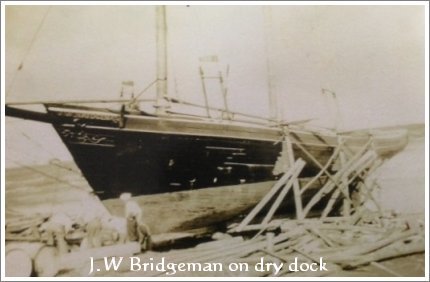
Our story begins on a small island on the southern tip of Cape Breton known as Isle Madame during the era of wooden ships and canvas sails. A time when local men became involved in what is commonly known as 'the Coastal Trade'. This time of great opportunity also gave rise to the development of new tradesmen in the shipbuilding industry and brought forth the formation of captains, many of whom later became master seamen. It was also a time when great sailing captains immigrated to the region of Isle Madame to take part in its prosperity.
In the early 1800's, Isle Madame became a prominent and important port of call for vessels heading to British North America and the American colonies; as well as the triangular trade base of North American fish traded for Caribbean rum and European goods. The busy port of Arichat on Isle Madame boasted 5 forges and 24 wharves!
Many families became prominent in the industry at this time, either as shipbuilders, ship owners, master seamen or a combination of the three, and are listed in 'Ships, Seafarers and Sailings: The Story of Isle Madame's Sailing Vessels' written by Merrill F. Boudreau. They are as follows:
- The Family Connection – Les Vigneau: 1818–1874
- The Mystery Builder & Owner – Simon LeBlanc: 1822–1871
- The Multiple Investor – Peter deCarteret: 1823–1871
- The Fleet Men – Les LeVesconte: 1823–1906
- The All-Round Owner – Benjamin Terrio: 1829–1874
- The Trade Builders – The Gruchys: 1834–1892
- The Immortals – Les Marmauds: 1835–1878
- The Master Owner – Charles Boudrot: 1849–1883
- The International Traveller – Simon Terrio: 1849–1899
- The Ideal Representatives – Les Lavache: 1856–1885
- The Brigantine Masters – Les Gagnon: 1858–1877
- Les Champions de Pêche – Les Boudrot: 1859–1920
- The Brigantine Connoisseur – Desiré LeBlanc: 1860–1880
- The Barque Dominator – Dominique Gerroir: 1863–1870
- The Vessel Life Extender – William Girroir: 1888–1904
- The Last Sail Hoister – Isadore Poirier: 1888–1925
The Girroir connection
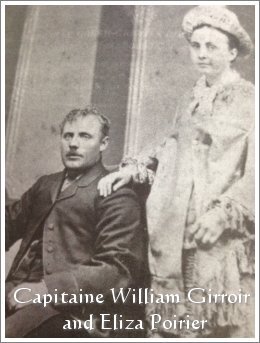
Our link to this impressive list is in the Girroir connection; namely, Benjamin Girroir (born 1799), William Girroir (born 1855), and the true 'Last Sail Hoister' and our café namesake, Captain Jean-Baptiste Girroir (born 1874).
William Girroir is our maternal great-grandfather. He sailed ships from 1888 to 1902 and was known as 'the Vessel Life Extender' for his ability to acquire previously used vessels and re-build them for future use. His vessels included the Advance, the Agility, the Spring Bird and the Ida C. Stafford.
Many great master craftsmen and shipbuilders, as well as master seamen, hailed from the West Arichat region of Isle Madame; William was one of them. Twice married, our maternal grandmother Mabel was his eldest daughter through his first marriage to Eliza Poirier. As told through the generations, William must have been an extremely modern thinker for his time; when, nearing the end of the shipping era and upon deciding to move his family through a second marriage to New England in the early 1900's, he left monies to Mabel for the 'education of her daughters'. Mabel chose to remain in West Arichat to see to the care of her younger siblings who wanted to remain there.
A truly exceptional man.
Captain Jean-Baptiste Girroir and the J.W. Bridgeman
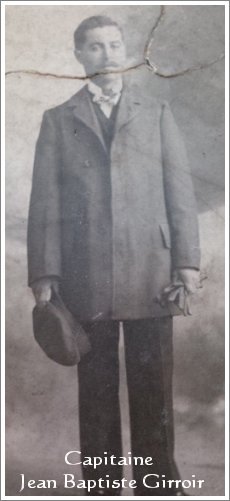
Benjamin Girroir, our great-great-grandfather on our mother's father's side, owned a two-masted schooner, le Bacalieu, in 1857. His grandson and our grandfather, Captain Jean-Baptiste Girroir, owned a number of vessels. The last being the J.W. Bridgeman, the café's namesake vessel.
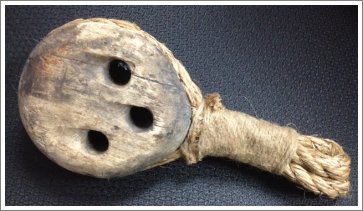
Captain Jean-Baptiste Girroir sailed the J.W. Bridgeman only two years (1938 & 1939) and was forced to abandon his craft after suffering an injury to his hand while repairing the vessel. Although this ended his career as a sea captain, he left behind the most artifacts from this era; notably, his sailing charts, his ledger and parts of the vessel's rigging. Many of his antique maps have been framed and are available for viewing at the café. His rigging has been incorporated into the replica of the J.W. Bridgeman which is used as the service counter for la goélette à pépé café.
This time of great prosperity (1850–1890) included over 470 ship builders, 778 ship owners (with the LeBlanc surname registering the most at a total of 64 vessels) and roughly 1,600 vessels registered at the port of Arichat. Author Merrill F. Boudreau notes the 'Charlotte' as the first ship registered in 1774.
Together, these Pépés' character, intelligence, innovation, ingenuity and plain hard-working ethics were the foundation of the history and heritage of the sailing era of Isle Madame. It was dangerous work which claimed many lives and involved weeks, months and sometimes years of sailing port to port around the globe.
Their time and efforts are now part of our history and heritage. Something which we all share and for which we should be very proud… It is not only our story, but it is your story as well. Read more on our blog.
Join us at the café… in the celebration of an era of wooden ships and iron men!